
Feelings Are Not Facts: Biblical Perspective
Inside: Feelings Are Not Facts
Have you ever danced with the idea that ‘feelings are not facts’?
It’s not just a saying, but a golden nugget of wisdom. Join me on this journey of exploration, and together, we’ll uncover how this insight can truly brighten our understanding.
See what the Bible says about feelings below.
Is It True That Feelings Are Not Facts
From a biblical point of view, feelings and facts are different, but both are important. Let’s break it down:
- Feelings Are Real But Not Always Reliable: Our emotions are a part of the human experience. God designed us to have feelings, and throughout the Bible, individuals express a wide range of emotions. King David in the Psalms, for instance, displays a gamut from deep despair to ecstatic joy. Yet, feelings can sometimes mislead us or be based on misunderstandings or misconceptions.
- The Heart Can Be Deceptive: The Bible says in Jeremiah 17:9, “The heart is deceitful above all things, and desperately wicked: who can know it?” This suggests that our feelings and emotions, which often emanate from the heart, can sometimes be deceptive. They might not always reflect the objective truth or facts of a situation.
- Basing Decisions on Truth: Proverbs 3:5-6 advises, “Trust in the LORD with all your heart, and lean not on your own understanding; in all your ways submit to him, and he will make your paths straight.” This suggests that instead of relying solely on our feelings, we should seek God’s wisdom and grounding in His Word, the Bible.
- Feelings vs. Faith: Often in the Bible, believers are encouraged to walk by faith and not by sight (2 Corinthians 5:7). This means that even if feelings make us doubt or fear, we can choose to trust in God’s promises and truths.
- Jesus’ Experience: Even Jesus, in His humanity, experienced a range of emotions. In the Garden of Gethsemane, He felt deep sorrow and distress, but He chose to submit to the Father’s will over His feelings (Matthew 26:39).
In conclusion, from a biblical perspective, while feelings are real and valid, they aren’t always indicative of objective facts or truth.
The Bible advises seeking wisdom, grounding decisions in Scripture, and trusting in God’s promises, especially when feelings might lead us astray.
The goal is to understand your emotions and the message they are sending you. You do not want your emotions to be the boss of you. You want to be the boss – empowered!
Warrenton
How Do You Separate Feelings From Facts
Separating feelings from facts is a valuable skill, especially when navigating complex situations.
Here’s a biblically-inspired, step-by-step guide to help you:
- Prayerful Reflection: Start by asking God for wisdom, as James 1:5 encourages. This opens you up to clearer thinking.
- Identify the Feeling: Name what you’re feeling, whether it’s fear, anger, or jealousy. Recognizing the emotion helps you address it.
- Seek Truth in Scripture: Use the Bible to guide you. As Psalms 119:105 says, it is a “lamp for your feet, a light on your path.”
- Gather Evidence: Look at the facts of the situation. What can be proven? Remember, as Proverbs 18:17 points out, to question the first explanation you hear.
- Talk it Out: Discuss your feelings with someone you trust. Proverbs 11:14 suggests that safety comes from having many advisors.
- Challenge Your Feelings: Consider if your feelings are based on the current situation or past experiences, which might distort your view.
- Wait and Reflect: Be patient and thoughtful before making decisions, as Proverbs 14:29 advises.
- Practice Mindfulness: Stay present to help separate emotional reactions from factual observations.
- Reaffirm Your Identity in Christ: When in doubt, remind yourself of your identity in Christ, as stated in Romans 8:37.
By using these steps and grounding yourself in biblical wisdom, you can better distinguish between feelings and facts and navigate life’s challenges more effectively.
Feelings are like signposts; they can alert us to something. But they are not determinative. We’re not at their mercy. We get to examine them for accuracy, then choose for ourselves what we believe about who we are and how we will decide to act.
Cassy
Can Feelings Be Valid But Wrong
This is an interesting question, especially from a biblical perspective. Let’s simplify it:
Validity of Feelings: Emotions are a real and genuine response to situations or thoughts, as God created us with the capacity to feel. Biblical figures like David and the apostle Paul show a wide range of emotions.
Misleading Feelings: Although our feelings are real, they can be misleading if based on misunderstandings or incomplete information. For example, feeling ignored because someone didn’t greet you might be a misinterpretation if they simply didn’t see you.
Feelings vs. Truth: The Bible warns that our hearts can be deceitful (Jeremiah 17:9), suggesting that our feelings, while real, can sometimes lead us away from the truth.
Emotions in Decision Making: It’s important to acknowledge our emotions but also to check them against God’s wisdom. Proverbs 3:5-6 teaches us to trust in the Lord and not rely solely on our own understanding.
Constructive Reflection: Emotions can signal areas in our lives that need attention, such as envy prompting us to consider our contentment and perspective.
In summary, feelings are both real and can be misleading. They reflect our internal state but can be based on wrong assumptions. Recognizing, understanding, and weighing our feelings against biblical truths helps us make informed decisions.
In the dance of life, feelings are the music, but it’s wisdom that guides our steps.
Coffee With Starla
What Does The Bible Say About Feelings
The Bible has much to say about feelings, given that it spans a vast array of human experiences.
Here’s an overview of what the Bible says about feelings:
- Feelings are Genuine and Valid: Throughout the Bible, we encounter figures who expressed a wide range of emotions. King David, for example, expressed feelings from joy and gratitude to despair and sorrow in the Psalms.
- The Heart’s Deception: The Bible cautions that our feelings, which often spring from our hearts, can be misleading. Jeremiah 17:9 says, “The heart is deceitful above all things and beyond cure. Who can understand it?” This underscores the importance of discernment.
- Guidance Over Gut: While feelings are an integral part of human experience, Proverbs 3:5-6 advises not to rely solely on them: “Trust in the LORD with all your heart and lean not on your own understanding.”
- Jesus and Emotion: Jesus, in His humanity, displayed various emotions. He felt compassion for the crowds (Matthew 9:36), anger in the temple (John 2:15), and profound sorrow at Lazarus’s death (John 11:35).
- Walking by Faith: The New Testament often emphasizes faith over feelings. 2 Corinthians 5:7 reminds us, “For we live by faith, not by sight,” suggesting that our trust in God should guide us, even when our feelings might make us doubt.
- Processing Anger: The Bible doesn’t condemn feeling anger but advises on how to handle it. Ephesians 4:26 says, “In your anger do not sin”: Do not let the sun go down while you are still angry.”
- Joy in Trials: The Bible acknowledges that feelings of joy can coexist with hardships. James 1:2-3 encourages, “Consider it pure joy, my brothers and sisters, whenever you face trials of many kinds because you know that the testing of your faith produces perseverance.”
- Peace that Transcends: Philippians 4:7 speaks of a peace “which transcends all understanding,” indicating that our feelings of peace can sometimes surpass what our current circumstances might suggest.
In essence, the Bible recognizes the depth and breadth of human emotions and offers guidance on how to navigate them.
Feelings are seen as natural and authentic, but believers are also encouraged to anchor themselves in God’s truth, wisdom, and promises, especially when emotions become overwhelming or challenging.
Feelings light the way, but clear thinking paves the path
Coffee With Starla
Emotions In The Bible
What does the Bible say about emotions?
Here’s a glimpse into some prominent emotions in the Bible:
- Love: One of the most celebrated emotions, love is central to the Bible’s teachings. Scriptures like 1 Corinthians 13 extol the virtues of love, while John 3:16 highlights God’s immense love for humanity: “For God so loved the world that he gave his one and only Son.”
- Joy: Despite the challenges and tribulations faced by many biblical figures, joy is a recurring theme. The Psalms often sing of joy, such as Psalm 16:11, “You make known to me the path of life; in your presence there is fullness of joy.”
- Fear and Anxiety: Many characters in the Bible grapple with fear, but they’re often comforted by God. Isaiah 41:10 says, “So do not fear, for I am with you; do not be dismayed, for I am your God.”
- Anger: Instances of righteous anger, like Jesus cleansing the temple (John 2:13-16), coexist with warnings against unchecked wrath, like Ephesians 4:26: “In your anger do not sin.”
- Sadness and Despair: Laments and expressions of grief are plentiful, particularly in books like Job and Lamentations. Even Jesus expressed profound sorrow, like when he wept over Jerusalem (Luke 19:41) or at the death of Lazarus (John 11:35).
- Peace: The peace offered by God, often described as surpassing understanding, is a cherished emotion in scriptures. Philippians 4:7 mentions, “And the peace of God, which transcends all understanding, will guard your hearts and your minds in Christ Jesus.”
- Hope: Amidst adversities, hope shines through in many biblical narratives. Romans 15:13 says, “May the God of hope fill you with all joy and peace as you trust in him.”
- Jealousy and Envy: The Bible addresses the perils of envy, such as in Proverbs 14:30: “A heart at peace gives life to the body, but envy rots the bones.” God also describes Himself as a “jealous God” in Exodus 20:5, indicating a zeal for His people’s undivided worship.
- Compassion: Many stories, like the Good Samaritan (Luke 10:25-37), emphasize compassion. Jesus often had compassion on the crowds, healing the sick and feeding the hungry.
- Regret and Repentance: Characters like King David, after his transgression with Bathsheba (Psalm 51), express profound regret and seek repentance.
The Bible’s portrayal of emotions underscores the richness and complexity of the human experience.
It offers solace, guidance, and understanding, affirming that emotions, in all their diversity, are integral to the human journey with God.
Scripture On Managing Our Emotions

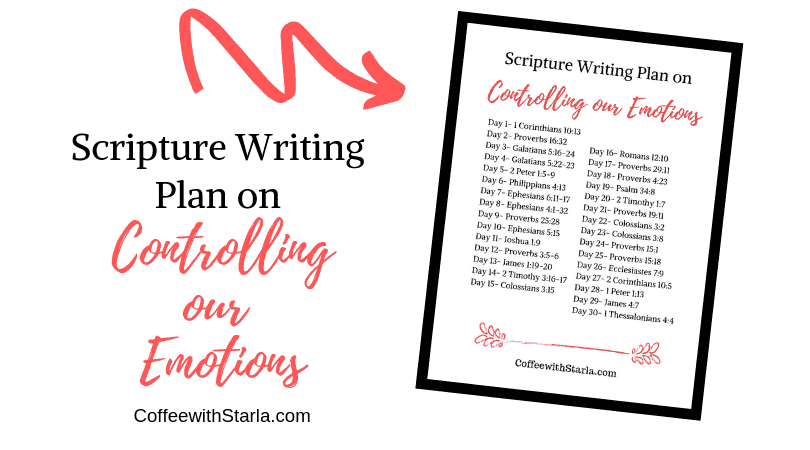
Want more bible verses on feelings and emotions? I wrote a 30-day scripture writing plan (bible reading plan) on Scriptures On Feelings.
If you’re wanting to know what the Bible says about emotions this is the bible reading plan for you.
Original price $4.00
Now only $0.00

How Do You Live By Faith And Not By Feelings
- Study the Bible: The Bible is the foundation of the Christian faith, and it provides guidance on how to live a life of faith. Christians should regularly read and study the Bible to understand God’s promises and to develop a deeper relationship with Him. Use God’s word to help you manage your feelings and heal from your past.
- Pray: Prayer is a way to communicate with God and express faith in Him. Christians should pray regularly, both to build their relationship with God and to ask for guidance with their feelings.
- Join a community of believers: Christians are not meant to live in isolation. Joining a community of believers can provide support and encouragement when faith is challenged. As Christian women, we need each other!
- Focus on God’s character and promises: Rather than relying solely on feelings, Christians should focus on God’s character and His promises. God is faithful and true to His promises, even when circumstances may suggest otherwise. Read these prayers for God’s help.
- Practice obedience: Living by faith involves not only believing in God but also obeying His commands. Christians should strive to live in a way that is pleasing to God, even when it is difficult. What are you focusing on? What are you watching? Are you allowing your feelings to guide you to seek God for healing? Or are they dominating your life?
Feeling alone in your faith journey? You don’t have to be.
Come join my online women’s Bible study—where real-life struggles meet real community. Grow in your walk with God, find encouragement for the hard days, and build soul-deep friendships with women who get it.
No pressure. No pretending. Just Jesus, coffee, and sisters who care.

Pin this article on “Feelings Are Not Facts” for later!